
AI Automation
AI Transformation for SMEs: 5 Stages & a 90-Day Roadmap
 Vivian Rothberg October 2026 10 min read
 Start with one process.
AI transformation, for a small or medium-sized business, means changing one process at a time so that AI does part of the work, then doing the same for the next process. It does not need a company-wide programme, a new platform or a board-level strategy deck. The practical route is a five-stage maturity model to score where you are today, and a 90-day first cycle that takes one process from idea to live.
This article explains what AI transformation means at SME scale, sets out the five stages and gives a 90-day roadmap you can start this quarter. It then covers connecting AI to your existing systems and data, why tools go unused after rollout, and the governance basics for a UK business. The five-stage model and the roadmap are our own frameworks, not an industry standard. Every public figure is linked to its source.
Key takeaways
- For an SME, AI transformation is a sequence of single-process changes. Pick one process with a measurable cost, prove it, put it into production, then repeat.
- Our five stages are Ad hoc, Guided, Piloted, Integrated and Compounding. You can score each process yourself, and each stage has one next move.
- Most of the effort goes into choosing the right process, connecting the AI to your systems and data, and training the people who use it.
- If you cannot name a process that costs real time or revenue, waiting is a sensible answer. The 90-day plan is for when you can.
- Governance starts small for a UK business: a one-page policy, and a check of the ICO’s guidance on AI and data protection.
What is AI transformation for an SME?
AI transformation is changing how a business runs so that AI does part of the work inside its core processes, rather than sitting beside them as a chat window. Large consultancies use the phrase for multi-year programmes. At SME scale it means one process, then the next.
The UK numbers show how early most businesses are. The ONS reported that “In September 2026, 3 in 10 (30%) businesses reported use of at least one type of AI technology” (ONS Business Insights and Conditions Survey, published 8 October 2026). Among businesses with fewer than 10 employees the figure was 29%, and among those with 10 or more it was 38%.
Depth is the sharper figure. In the June 2026 wave, among businesses with 10 or more employees that use at least one AI technology, only 10% reported using AI extensively (ONS, released 20 July 2026).
Using AI and being transformed by it are different things. A team that drafts emails with a chat tool has adopted AI. A business where AI drafts the renewal email from the CRM record, a person approves it and the result is measured has started to transform. The five stages below put words to that gap.
What are the five stages of AI transformation?
There is no official five-stage standard. The model below is our own AI maturity model, written for SMEs. It describes a path from scattered use to AI that runs in production.
| Stage | What it looks like | Next move |
|---|---|---|
| 1. Ad hoc | Staff use AI tools alone, with no shared rules | Agree tools and data limits |
| 2. Guided | Approved tools, a policy, trained staff | Pick one process to measure |
| 3. Piloted | One process, one owner, a before-and-after number | Connect it to your systems |
| 4. Integrated | AI works inside your CRM or inbox, people review exceptions | Add the next process |
| 5. Compounding | Several processes live, measured monthly, extended by your team | Review data, cost and risk each quarter |
Score each process, not the whole company. Marketing may sit at stage 3 while finance sits at stage 1. For each one, choose the highest stage whose description is true today for work that touches revenue or cost. A demo does not count.
If you want an outside score, our AI readiness assessment is a one-week programme at £3,000. It maps your data, workflows and team skills, and gives you a proposal to keep.
The ONS depth figure suggests most businesses sit in the first two stages. That mapping is our reading, since the ONS does not use these stages.
Two rules keep the model honest. Do not skip a stage, because an integrated tool is wasted where nobody has agreed which data it may use (stage 2) or which process matters most (stage 3). And moving one process up a stage is worth more than planning a move for ten.
Is AI transformation worth it for a small business?
It is worth it where you can name a process that costs real time or loses real revenue, and not worth it yet where you cannot. The government’s research points the same way. In DSIT’s AI adoption research, the biggest preventing factor for businesses with no plans to adopt AI was a lack of identified need, at 81% (DSIT, AI Adoption Research, fieldwork February to May 2025).
For some businesses that is the right answer. A short test separates the two cases.
| Act now if | Wait if |
|---|---|
| A task repeats every week and takes hours | You cannot name a process that costs time or revenue |
| The data is digital and one person can reach it | The data sits on paper or in inboxes nobody owns |
| A person can check the output quickly | Nobody has time to review what the AI produces |
| You can measure it before and after | You cannot say what good looks like |
Our guide to where automation actually pays off shows how to compare candidate processes on frequency, effort and risk.
Starting with one process is also the shape of our worked example. SBU, a UK energy broker, had us build an automation layer across Salesforce, an LLM (Anthropic Claude) and its email. Outreach is triggered by contract end date, replies are classified and responses drafted for approval, and an 85% confidence threshold decides what runs automatically. Within three months the team was generating five times the qualified leads, without adding headcount.
A 90-day AI roadmap for an SME
A 90-day cycle is long enough to put one process into production and short enough to stop if the numbers do not work. The plan below is how we would sequence it. The timings depend on how quickly data access and approvals arrive, so treat them as targets.
Days 1 to 14: pick and validate one process
Choose a process that repeats at least weekly, has a named owner, uses data you can already reach, and produces output a person can check. Write down the baseline before anything is built: hours a week, volume, rework and turnaround time.
End the fortnight with a one-page brief and a go or no-go decision. If no process passes, stop. The cost of finding that out is small, and the result is useful.
Days 15 to 45: pilot on real data
Build the narrowest version that does real work. Use an off-the-shelf tool if one does the job. Use an AI agent when the work spans several systems, and our guide to what an AI agent is explains where that line falls.
A person reviews every output during the pilot. Compare the results with the baseline at day 45 and choose one of three outcomes: continue, change the scope, or stop.
Days 46 to 75: connect it and go live
Move the pilot into the systems where the work happens. Add a confidence threshold, an exception queue, logging, and a rule that a person approves anything that leaves the building. A first AI agent for one scoped job starts from £5,000.
Days 76 to 90: train, measure, decide
Train the people who use the result, measure it against the baseline, and write down the next three candidate processes. Then decide whether to repeat the cycle. This is where stage 3 becomes stage 4 for that process.
What to avoid in the first 90 days
- Buying a platform before choosing a process. The process decides the tool.
- Piloting in a corner nobody owns. A pilot without an owner has no one to push it into production.
- Skipping the baseline. Without a before number, every result is an opinion.
- Letting AI send anything external unreviewed. Start with a person approving.
- Writing a company-wide strategy before one thing works. One live process teaches more than a slide deck.
How to connect AI to your existing systems and data
Value arrives when AI works where the work happens. A chat window produces text that a person copies into a system. An integrated setup reads the record in your CRM and drafts the email in your inbox. That is the move from stage 3 to stage 4.
SBU shows the shape. The automation is a layer across Salesforce and the client’s email, and it calculates each customer’s savings from the client’s own editable rate table.
Before connecting anything, check three things about the data:
- Reach. Is the data digital, and can the system read it through an API or a scheduled export?
- Trust. Is it accurate enough that a person would act on it without checking?
- Permission. Are you allowed to use it this way? Personal data brings the UK GDPR in, covered below.
If data is the blocker, fix it first. A data audit from £3,000 shows where your data stands before you build anything on it.
Why AI tools go unused after rollout
AI tools go unused when nobody owns the outcome and nobody was shown the real task. Skills are the recurring theme in UK research. The ONS found that “Among businesses that do report challenges, a lack of expertise is one of the most cited barriers” (ONS, June 2026). Across all the businesses DSIT surveyed, limited AI skills, expertise and knowledge was the second most common barrier to adoption, at 60% (DSIT).
Even among businesses that already use AI, DSIT reported that just over half (54%) feel ready to scale their use. Getting people to use a tool is a project of its own.
AI change management does not need a programme. These habits cover most of it:
- Name one owner per process. That person decides whether the output is good enough.
- Train on the real task. Use your own documents and your own customers’ queries, not a generic demo.
- Change the written process. If the old procedure still says “copy this into the spreadsheet”, people will follow it.
- Agree the review rule. Say who checks what, and when the AI’s output may go out without a check.
- Ask what people avoid. Staff who skip the tool will usually tell you why.
Our AI literacy workshops train teams on their own tools and workflows, from £1,500 for up to 15 people.
AI governance basics for a UK SME
Start with a one-page policy and a data check. The policy lists which AI tools are approved, what data must never be pasted into them, who reviews outputs and who to ask when unsure. It is our advice rather than a legal requirement, and it is cheap.
For personal data, the ICO’s guidance on AI and data protection covers accountability, transparency, lawfulness, fairness and security. The ICO says on that page that the guidance is under review because of the Data (Use and Access) Act, so check it for the latest position.
A data protection impact assessment (DPIA) is required where processing is likely to result in a high risk to people’s rights and freedoms. The ICO’s list includes innovative technologies, including AI, when combined with another criterion (ICO, when do we need a DPIA). Screen for this at the start of a project.
If a supplier builds an AI system for you, ask how they follow the NCSC’s guidelines for secure AI system development. They are written for providers and cover secure design, development, deployment, and operation and maintenance.
This section summarises public guidance and is not legal advice. Check your own position with a data protection adviser.
Your next step
Score your top three processes on the five stages, then pick the one with the clearest measurable cost. That is the process for days 1 to 14 of the roadmap.
If you want a second opinion before committing, our AI readiness assessment is a £3,000, one-week programme that includes an honest verdict where AI is not worth it. A follow-on build starts from £8,000. If you want a fuller plan across the business, see AI strategy consulting. If you already know the process, AI automation consulting takes it into delivery.
Scope and price are fixed and agreed before work starts, and you pay by milestone as each stage is delivered. On a build, you can cancel within the first 21 days for a full refund. All code and IP are yours once the work is delivered and paid for.
Frequently asked questions
What is an AI transformation?
An AI transformation is changing how a business runs so that AI does part of the work inside its core processes. In large enterprises that is often a multi-year programme. For an SME we treat it as a sequence of single-process changes: choose one process with a measurable cost, pilot it, connect it to your systems, train the team, measure the result and repeat with the next process.
What are the five stages of AI transformation?
There is no official standard, so the five stages here are our own: Ad hoc (staff use AI tools alone), Guided (approved tools, a policy and trained staff), Piloted (one process with an owner and a before-and-after number), Integrated (AI working inside your CRM, inbox or back office) and Compounding (several processes live, measured and extended by your own team). Score each process separately.
What are the three pillars of AI transformation?
There is no agreed set of three. The three areas we examine in our one-week AI readiness assessment are your data, your workflows and your team's skills. They are also the three places a project can stall: data that cannot be reached, a process nobody has defined, and staff who have not been shown how to use the result.
How much does it cost for an SME to start with AI?
Our AI readiness assessment is £3,000 for a one-week programme, with a proposal to keep and no obligation to build. A first AI agent for one scoped job starts from £5,000, and team training starts from £1,500 for up to 15 people. Scope and price are fixed and agreed before work starts.
How do you build an AI roadmap?
Work in 90-day cycles, one process at a time. Days 1 to 14: choose and validate one process and record a baseline. Days 15 to 45: pilot it on real data with a person reviewing every output. Days 46 to 75: connect it to your systems and put it into production. Days 76 to 90: train the team, measure against the baseline and pick the next process.
Want to build something like this?
Book a free 20-minute consultation and we'll help you find where automation pays off.
Keep exploring
-
 How to Choose an AI Automation Agency in the UK
An honest buyer's guide to choosing an AI automation agency in the UK — what they actually do, the questions that separate the good from the bad, the red flags to walk away from, and how a small first project de-risks the whole decision.
Read more -
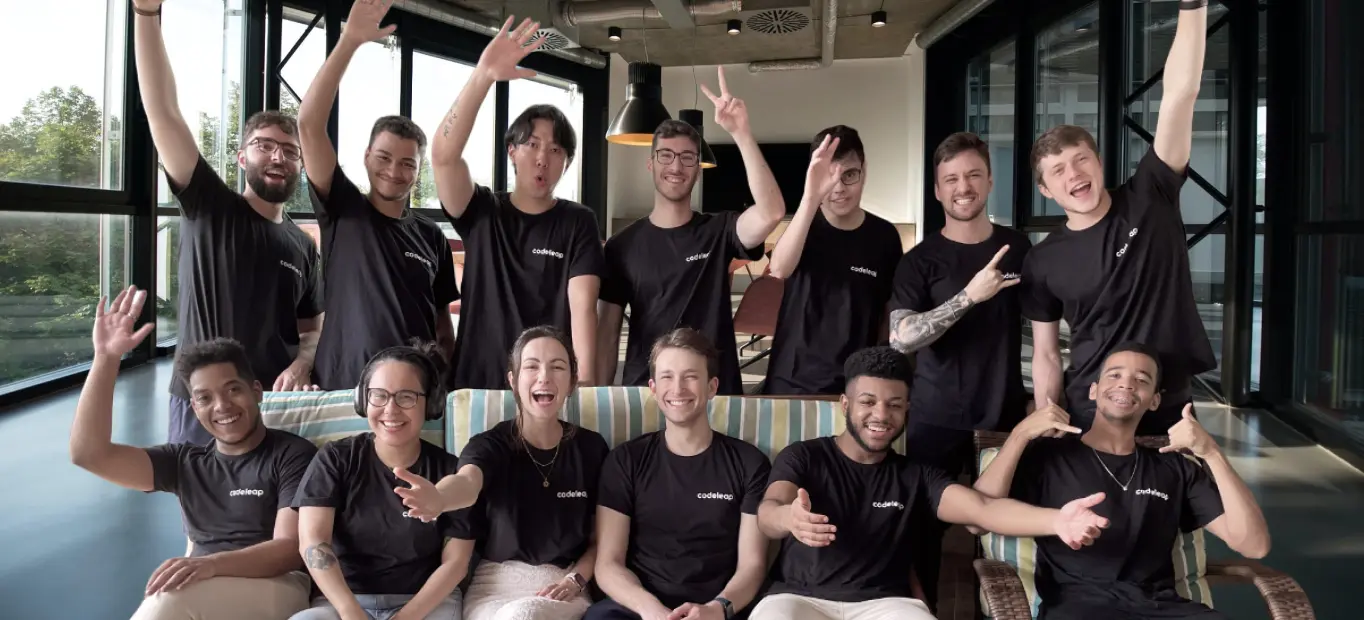 Meet the team!
We're a fully remote company: a 28-strong global team of designers, developers, data scientists, project managers and QA testers, with leadership in London. Here's who's on the team — and how the 2024 all-team retreat in Brazil went.
Read more