
Product Development
Transport Management System: Buy One or Build Your Own?
 Victor Gimael November 2026 12 min read
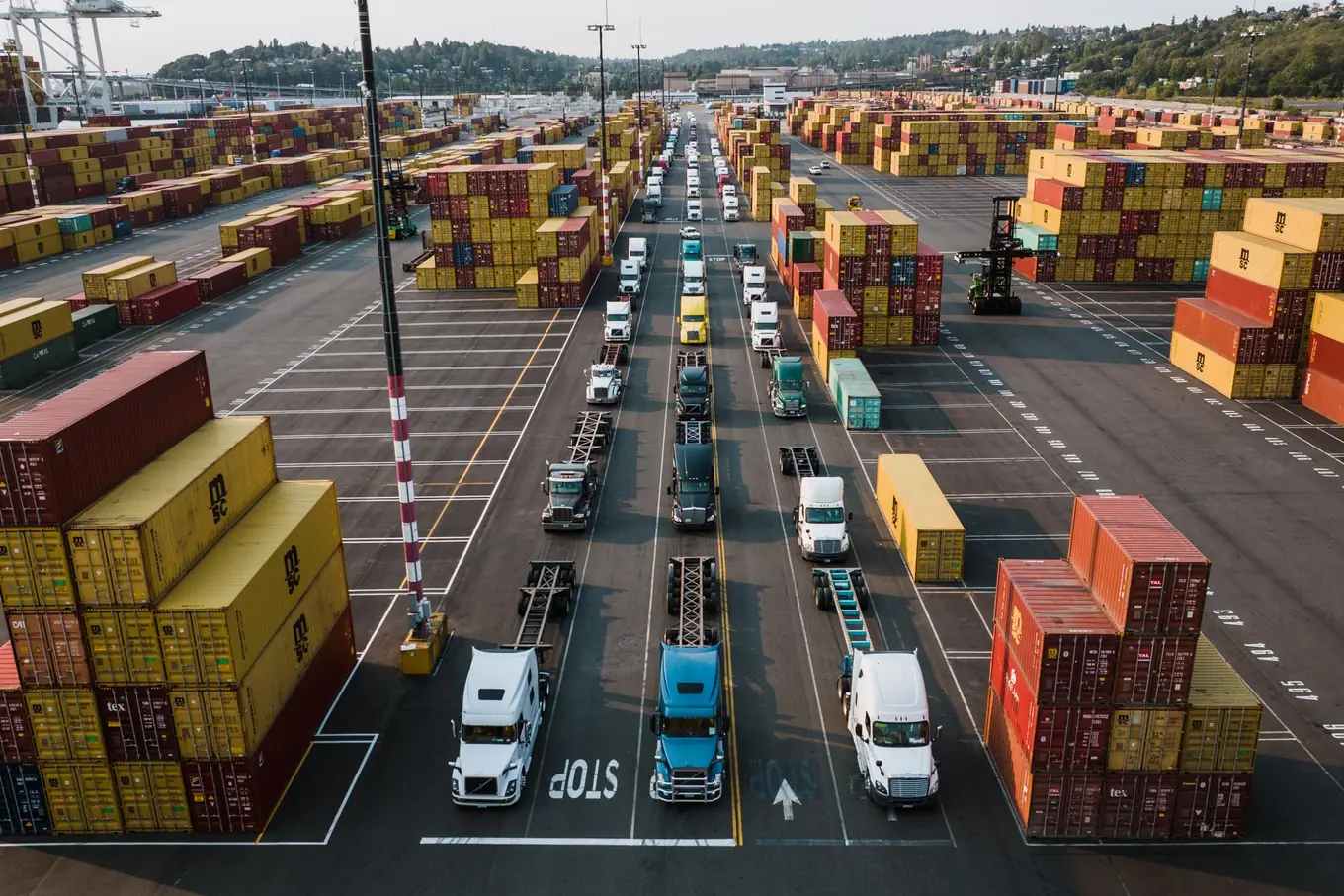 Does your TMS fit the work?
Most hauliers, couriers and carriers should buy a transport management system rather than build one. US readers will know it as a transportation management system (TMS). If your jobs look like most general haulage or trucking work, a product made for that work will cost less than a build and carry less risk. Build your own only when no product models how you run jobs, or when the gaps around your TMS cost more than closing them.
Often the right answer sits in between: keep the TMS and build the missing pieces around it. Those pieces are what we offer on our transport and logistics page: driver apps, planning tools, proof of delivery (POD) to invoice automation, and integrations. We should say plainly that we haven’t shipped a dedicated transport or logistics build we can write up yet. This guide covers what a TMS does, the three routes, published prices, the UK and US rules a TMS has to fit, and how to decide.
Key takeaways
- Most small and mid-sized operators should buy a TMS and configure it properly before they consider a build.
- Keeping your TMS and building the missing pieces around it often fixes the real problem for less.
- Build your own TMS only when no product models your work, or the workarounds cost more than owning the software.
- Any TMS has to fit drivers’ hours, tachograph and walkaround-check rules in the UK, and hours-of-service and electronic logging device rules in the US.
- Ask any vendor or developer about APIs, data export, offline driver apps, data ownership and the cost at your future size.
What does a transport management system do?
A transport management system plans, runs and bills the movement of goods. It turns an order into a job on a vehicle, tracks it, records the delivery and invoices it. Most products cover the same core jobs:
- Planning and optimisation: grouping orders into loads and routes that fit vehicles, time windows and drivers’ hours.
- Dispatch: sending jobs to drivers, usually through a phone app.
- Tracking: showing where each job is, from telematics or the driver app.
- Proof of delivery: signatures and photos captured at the drop.
- Carrier management and rating: subcontracted work and the rates agreed with each carrier.
- Freight audit and billing: checking carrier invoices and raising your own.
- Reporting: cost, margin and on-time performance by customer, lane or vehicle.
A TMS rarely works alone. Most operators also run telematics in the cab, and in the US electronic logging devices (ELDs). Add a warehouse system for some, and an accounts package such as Xero, Sage or QuickBooks. How well these connect decides how much rekeying your office does.
Is SAP a TMS?
Yes. SAP sells SAP Transportation Management, and SAP’s own product page presents it as a transportation management and logistics system. If your business already runs SAP, ask SAP how it connects to what you have. The questions later in this guide apply to it as they do to any TMS.
Buy, build, or build around your TMS?
There are three routes, and most operators should take the first or the second. The table sets them side by side.
| Route | Fits when | Watch for |
|---|---|---|
| Buy a TMS | Your work is standard | Fees that grow with fleet size |
| Build around it | The TMS fits, the gaps don’t | Each new piece needs an owner |
| Build your own | No product models your work | Cost, time and upkeep |
Buy. A product built for haulage or trucking already handles orders, dispatch, PODs and invoicing, and the vendor maintains it. Configure it properly before you judge it: customers, rates, vehicle types and the integrations it offers.
Build around it. Keep the TMS and close the gaps it leaves. Typical gaps are a planning spreadsheet beside the TMS, rekeying into the accounts package and paper PODs that delay invoicing. Others are subcontracted work the TMS can’t model and walkaround checks still done on paper. Each can be closed without replacing the TMS, if it has an API or a dependable export. Our guide to API integration explains the options.
Build your own. A bespoke TMS makes sense when no product is designed for work like yours. Think unusual loads, contract logic no product handles, or a TMS your customers log in to. It is the slowest and most expensive route, and the upkeep becomes yours. If an in-house system has aged badly, our guide to legacy systems covers whether to refactor, rebuild or replace it.
How much does a TMS cost?
Off-the-shelf TMS products charge per office user, per driver device, per truck, per load or as a flat tier, and some quote on request. At the time of writing (November 2026), the three below publish prices on their own pricing pages.
We sell none of these products and none of them pays us. They are listed A to Z with the same fields, taken from each vendor’s own pricing page and checked 20 November 2026. HaulierMagic prices in pounds, and Datatruck and Truckbase in dollars. Other TMS products exist, and vendors are welcome to send corrections.
| Product | Published price | Basis |
|---|---|---|
| Datatruck | Free to $299 a month | Tiers by truck count |
| HaulierMagic | £99 per office user, £15 per driver device, a month | Monthly, excluding VAT |
| Truckbase | From $290 a month | Minimum, billed annually |
Datatruck’s pricing page lists Freemium at $0 for up to 3 trucks and Basic at $99 a month for up to 6. Pro is $299 a month for up to 19 trucks, and its Big Fleet and Enterprise tiers are priced as Custom.
HaulierMagic’s pricing page lists its Standard plan, for up to 12 users and vehicles, at £99 per office user and £15 per driver device a month, excluding VAT. Its Volume plan, above 12 users and vehicles, drops the office-user price to £79.
Truckbase’s pricing page states a minimum of $290 a month, billed annually. It prices per truck, per driver, per load or at a flat annual rate.
What building costs with us
Our prices are fixed and agreed before work starts.
- Connecting two systems, such as your TMS and your accounts package: from £5,000 with our systems integration service.
- One automated process, such as POD to invoice: £2,000 to £10,000 for a single process build with our process automation service.
- Integrations and automations across what you already run: from £5,000. A bespoke software build, from design to live system, starts from £10,000.
- Maintenance and support: from £400 a month.
Transport projects start from £5,000, which suits a single focused automation such as POD to invoice. A planning tool, or a driver app (an app build that works with your TMS), costs more. A typical build takes around three months from design to launch.
An illustrative three-year comparison
This is illustrative. It assumes a UK operator with two office users and ten driver devices, using HaulierMagic’s published Standard plan and our published starting prices over 36 months. It excludes VAT, hosting and per-use services.
| Scenario | Inputs | Three years |
|---|---|---|
| Buy the TMS | (2 × £99 + 10 × £15) × 36 | £12,528 |
| Buy, plus a custom integration | £12,528 + £5,000 | From £17,528 |
| Bespoke build plus support | £10,000 + £400 × 36 | From £24,400 |
HaulierMagic’s pricing page also quotes from £500 to connect a system it already supports, such as Xero, Sage or Webfleet. The middle row applies only to a connection the product does not offer.
On these figures, buying wins for a ten-vehicle operator whose work fits the product. The bespoke row is a floor for a narrow build. A TMS covering everything in the list at the top of this guide would cost far more than £10,000. The case for building rests on what the product cannot do, and rarely on the subscription.
The rules a TMS has to fit in the UK and US
Software can make the rules below easier or harder to follow, so check how any TMS or driver app handles them. This is a summary of official guidance, not legal advice.
UK: drivers’ hours, tachographs and walkaround checks
The assimilated rules (previously called EU rules) apply to drivers of most goods vehicles over 3.5 tonnes. They allow a maximum of 9 hours’ driving a day, extendable to 10 hours no more than twice a week. Weekly driving is capped at 56 hours and any two-week period at 90 hours. A break of at least 45 minutes is due after no more than 4.5 hours of driving (GOV.UK).
Operators must schedule work so the rules are met and download vehicle unit data from digital tachographs at least every 90 calendar days. They must also be able to produce records to enforcement officers for 12 months (GOV.UK). A planning tool that ignores drivers’ hours creates work your transport manager has to undo.
DVSA’s guide to maintaining roadworthiness says daily walkaround checks can be done on a handheld device, with the results stored digitally. Electronic records of reported defects are acceptable, and must be available for 15 months along with any record of repair. A digital check app needs that retention designed in from the start.
US: hours of service and electronic logging devices
After 10 consecutive hours off duty, a property-carrying driver may drive a total of 11 hours. That driving must fall within the 14 consecutive hours after coming on duty (49 CFR 395.3).
A motor carrier must also install, and require each of its drivers to use, an ELD. Exceptions include drivers who need a record of duty status on no more than 8 days in any 30-day period. Drivers of vehicles made before model year 2000 are also exempt (49 CFR 395.8). Both links go to the 2025 annual edition of the Code of Federal Regulations, so check the current text before you rely on it.
In practice the ELD stays the record of hours. A TMS that reads remaining hours from it can plan loads a driver can legally finish, so ask which ELDs a product connects to.
A Florida example: port work and empty miles
A 2024 freight plan memorandum for the Florida Department of Transportation says its findings suggest Florida works mainly as a consumer state. More trucks leave it empty than arrive empty. On I-10 in 2022, 37.26% of the Class 9 trucks measured leaving the state were empty, against 15.17% of those entering (FDOT).
The same memorandum puts average truck detention in 2022 at 135 minutes at JAXPORT (Jacksonville) and 133 minutes at Port Miami, measured with geofencing and telematics.
For a Florida carrier hauling port containers, two features follow. Check for automatic capture of waiting time at ports and docks, and for planning that looks for a return load. If your drivers work in English and Spanish, check the driver app supports both.
Should a small haulier or carrier build its own TMS?
Usually not. Start with the cheapest step that fixes the problem you actually have.
| Your situation | What to do |
|---|---|
| Small fleet, standard work | Buy a TMS and configure it |
| TMS fits, office rekeys jobs | Connect it to your other systems |
| Paper PODs slow invoicing | Automate POD to invoice |
| Planners use a spreadsheet | Build a planning tool around the TMS |
| Checks and defects on paper | Add a driver check app |
| No product models your work | Scope it, then build your own |
| An old in-house system | Assess it before you replace it |
Build your own only if no product models how you work, or the workarounds cost more each year than owning the software. Otherwise, buy, and spend on the gaps.
To put a number on a gap, count the hours. Say two office staff each spend an hour a day rekeying jobs into the accounts package. Over 20 working days that is about 40 hours a month (illustrative: 2 people × 1 hour × 20 days). Set that against a fixed, one-off price for connecting the two systems.
What to ask a TMS vendor or a build partner
Ask a vendor and a developer the same questions, and get the answers in writing.
- APIs and data export. Can you get every job, rate and POD out at any time? Is there an API, and on which plan?
- Telematics and ELD integrations. Which trackers and ELDs connect today, and who maintains each connection?
- Accounts integration. Does each invoice reach your accounts package with the right customer, tax and account codes?
- An offline driver app. Do jobs, PODs and checks queue on the phone in a dead spot and sync when signal returns?
- Ownership. Who owns the data and the code? With a product you rent the software, so read the export terms.
- Cost at your size. What is the monthly cost per user, per truck or per load at your fleet size in three years?
- Leaving. What does it take to move off, and how long do you keep access to your data?
If a vendor offers a trial, run a week of real jobs through it, including your awkward ones, before you sign. With us, all code and IP are yours once the work is delivered and paid for.
What we have built, and what we haven’t
We haven’t shipped a dedicated transport or logistics build we can write up yet, and we would rather say so than dress one up. What we can show is neighbouring engineering. None of it is logistics work.
- A vehicle imaging platform, built over a multi-year engagement. iOS and Android apps guide each shot, a custom computer vision model locates the vehicle, and background replacement, quality control and 360-degree spins are automated. The infrastructure handles millions of images a year. What a driver app shares is guided photo capture on a phone.
- Skamper, a running app we built for iOS and Android and launched in three months. Its live event map shows every participant’s position in real time, outdoors on unreliable connections, without draining a phone. Tracking on weak signal is what carries over.
- SBU, a UK energy broker, where we built an automation layer across Salesforce, an LLM and the client’s email. Within three months the team was generating five times the qualified leads, without adding headcount.
Your next step
Write down the one gap that costs you most: the rekeying, the paper PODs, the planning spreadsheet or the missing integration. Note which TMS, telematics or ELD, and accounts package you run. Then book the free 30-minute consultation from our transport and logistics page, and we’ll tell you whether to configure, connect, build or leave things as they are.
Projects start from £5,000, with scope and price fixed before work starts and milestone payments as each stage is delivered. On a build, you can cancel within the first 21 days and get your money back in full. If you are in the US, the work is done remotely and the first call is online.
Frequently asked questions
What is a transport management system?
A transport management system (TMS) is software for planning, running and billing the movement of goods. It takes orders, plans loads and routes, dispatches jobs to drivers, tracks them, captures proof of delivery, manages subcontracted carriers and raises invoices. In the US it is usually called a transportation management system. A TMS normally sits beside telematics or electronic logging devices, sometimes a warehouse system, and an accounts package, and is connected to them.
How much does a TMS cost?
It depends on how the vendor charges. At the time of writing (November 2026), HaulierMagic lists £99 per office user and £15 per driver device a month, excluding VAT. Datatruck lists tiers from free for up to 3 trucks to $299 a month for up to 19 trucks, and Truckbase states a $290 a month minimum, billed annually. Larger fleets are often priced on request. With us, connecting two systems starts from £5,000 and a bespoke build from £10,000.
Is SAP a TMS?
Yes. SAP sells SAP Transportation Management, and SAP's own product page presents it as a transportation management and logistics system. If your business already runs SAP, ask SAP how it connects to the systems you have. If you are a smaller operator comparing options, put the same questions to SAP that you would put to any TMS vendor: integrations, data export, the driver app and the cost at your size.
Should a small haulier or carrier build its own TMS?
Usually not. If your work is standard general haulage or trucking, an off-the-shelf TMS costs less and is ready sooner. In our illustrative three-year example, two office users and ten driver devices on HaulierMagic come to £12,528 excluding VAT, against at least £24,400 for a narrow bespoke build plus support with us. Build when no product models your work, or when the gaps around the TMS cost more than closing them.
Can a TMS connect to our telematics and accounts software?
Often, yes. Vendors such as HaulierMagic and Truckbase list the telematics, electronic logging device or accounts integrations they support, so check yours are on the list and test them before you sign. Where a product has an API but no ready-made connector, a custom integration can close the gap, and connecting two systems with us starts from £5,000. Where a system has no API, scheduled exports can sometimes do the job.
Is your TMS leaving gaps?
Book a free 30-minute consultation and we'll tell you whether to configure, connect or build, or to stay as you are.
Keep exploring
-
 How Much Does It Cost to Build an App in the US? (2026 Prices)
What it costs to build an app in the US in 2026: what drives the price, developer pay from the BLS, Apple and Google fees in dollars, and our fixed prices by stage.
Read more -
 How Much Does It Cost to Build a Website in the US? (2026)
What it costs to build a website in the US in 2026: free and paid builder plans in dollars, what developer time costs, monthly running costs, ADA and privacy rules, and our fixed prices.
Read more